

Pingo AI vs Duolingo: Which Language App Wins?

2026-08-05
Pingo AI vs Duolingo comparison covering features, pricing, learning approach, speaking practice, and which app suits different types of language learners.
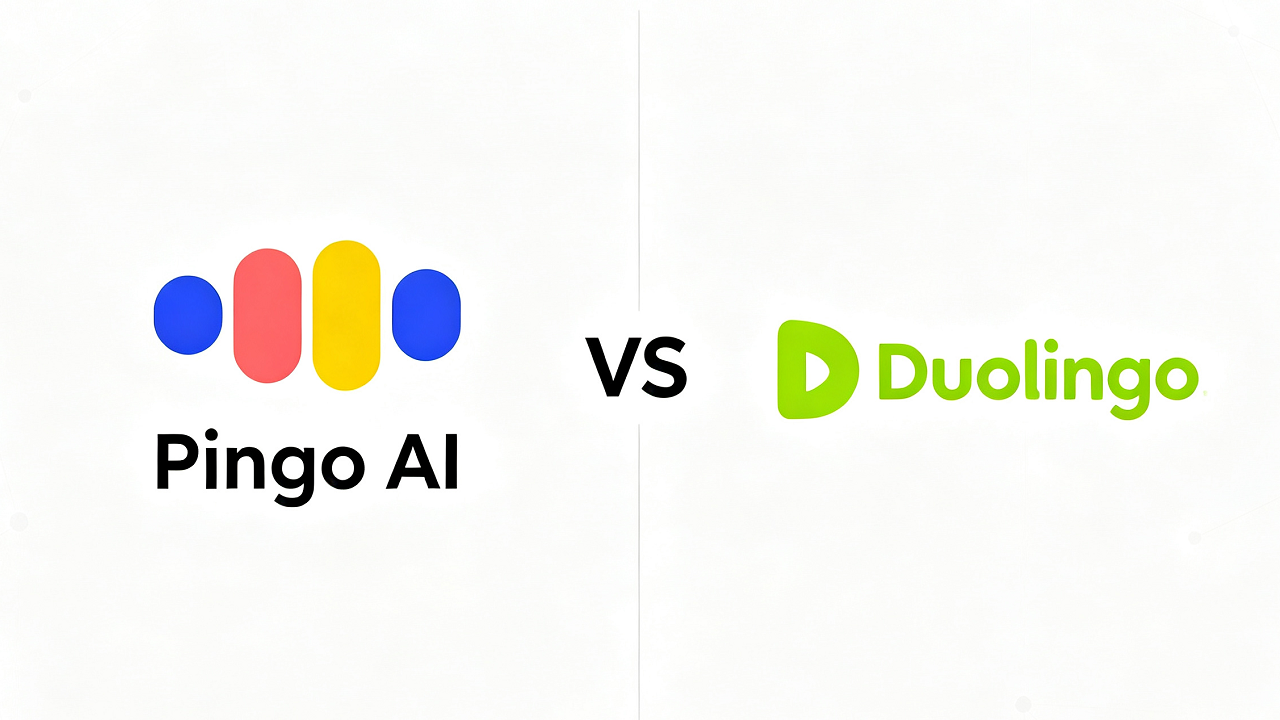
Pingo AI and Duolingo are the two language learning apps people compare most often right now. One won Google Play's Best of 2025 award for its AI conversation partner. The other has spent a decade as the most downloaded language app on the planet with over 500 million users.
They're not really the same product. Duolingo teaches you vocabulary and grammar through gamified exercises. Pingo AI makes you speak out loud in realistic conversations. The question isn't which one is objectively better. It's which one solves your specific problem.
Here's the full comparison across the dimensions that actually matter for learning a language.
Quick Comparison: Pingo AI vs Duolingo
| Feature | Pingo AI | Duolingo |
|---|---|---|
| Learning approach | AI conversation practice | Gamified lesson exercises |
| Best for | Speaking and fluency | Vocabulary and grammar |
| Languages | 25+ | 40+ |
| Free tier | Free trial (limited) | Free with ads (full access) |
| Paid price | $14.99/month | $6.99-$13.99/month (Super/Max) |
| Speaking practice | Core feature | Limited (Max tier only) |
| Grammar feedback | Detailed per-conversation | Answer-level correction |
| Offline access | No | Yes (Super/Max) |
| Best use | Practicing real conversations | Building foundational skills |
Learning Approach: Conversation vs Gamification
The biggest difference between Pingo AI and Duolingo is what they ask you to do.
Duolingo's approach: Short, game-like lessons. You translate sentences, match words to pictures, fill in blanks, and listen to audio clips. Each lesson takes 3 to 5 minutes. You earn XP, maintain streaks, compete in leagues, and unlock achievements. The app is designed to be addictive in the same way mobile games are. It works: Duolingo's daily active user numbers are massive because people genuinely enjoy using it.
The trade-off is depth. Duolingo teaches you vocabulary and basic sentence patterns effectively, but it doesn't prepare you to have a real conversation. You can complete an entire Duolingo course in Spanish and still freeze when someone asks you a question on the street. The app's exercises are about recognition (seeing and tapping), not production (speaking spontaneously).
Pingo AI's approach: Open-ended conversation. You pick a scenario or topic, and you talk. The AI responds like a real person would, adjusting to your level. After the conversation, you get detailed feedback on grammar, fluency, vocabulary, and relevance. There are no points, no leagues, no animations. The motivation comes from the satisfaction of actually communicating in a new language.
The trade-off is structure. Pingo AI doesn't teach you vocabulary from scratch or walk you through grammar rules step by step. Its Tutor Mode helps beginners, but it's not a full curriculum. If you're starting from zero, you'll need another resource for the basics.
Neither approach is wrong. They target different stages of learning and different skills. Most serious language learners use both types of tools: structured lessons for building knowledge and conversation practice for applying it.
Speaking Practice: Where Pingo AI Pulls Ahead
This is the clearest area of difference between the two apps.
Pingo AI is built around speaking. The entire experience revolves around voice conversations. You speak, the AI responds, you respond back. The feedback system is designed to improve your speaking specifically: it flags pronunciation issues, unnatural phrasing, and grammar mistakes in real conversational context.
Duolingo's speaking exercises, even in the Max tier, are limited. You might repeat a sentence into your phone, and the app checks if you pronounced it roughly correctly. But you're not having a conversation. You're not responding to unexpected questions. You're not thinking on your feet in a foreign language.
Duolingo Max ($13.99/month) added "Roleplay," an AI conversation feature that's conceptually similar to Pingo AI. You can have short conversations with an AI character in specific scenarios. It's a step in the right direction, but the conversations are shorter, the scenarios are fewer, and the feedback is less detailed than Pingo AI's analysis. Duolingo's Roleplay feels like a feature they added to compete. Pingo AI's conversation partner is the whole product.
If speaking is your main goal, if you can already read and write your target language but can't hold a conversation, Pingo AI does something Duolingo fundamentally doesn't.
Pricing: Free vs Paid Models
Duolingo has a real free tier. You can complete every lesson in every language without paying. The free version shows ads and limits your hearts (you lose a heart for each mistake, and run out of hearts means you stop practicing until they refill or you watch an ad). For casual learners, the free tier is genuinely usable.
Pingo AI doesn't have a permanent free tier. You get a free trial to test the app, then you need a Pro subscription ($14.99/month or $83.99-$99.99/year) to continue. There's no ad-supported free version.
Duolingo Super removes ads and gives unlimited hearts for $6.99/month (annual) or $12.99/month. Duolingo Max adds AI roleplay and answer explanations for $13.99/month (annual). Pingo AI Pro starts at $14.99/month or about $7-$8.33/month on the annual plan.
For price alone, Duolingo wins if you're cost-conscious. The free tier is genuinely functional, and even the paid tiers are cheaper than Pingo AI. But you're paying for different things: Duolingo's paid tiers mainly remove friction (ads, hearts), while Pingo AI's subscription gives you a fundamentally different learning experience (AI conversations).
Grammar and Feedback Quality
Both apps give you feedback, but the depth and format are different.
Duolingo corrects your answers immediately. Wrong translation? The app shows you the right one. Grammar mistake? A short explanation pops up (more detailed with Max). The feedback is tight and specific to the exercise you just did. It's effective for what it does: you learn grammar rules incrementally through pattern recognition and repetition.
Pingo AI's feedback is richer but less frequent. After an entire conversation, you get a report card across five dimensions: grammar, fluency, vocabulary, engagement, and content relevance. Each dimension has specific examples pulled from your conversation. "You used the informal 'tu' with a stranger, 'usted' would be more appropriate here." That kind of feedback teaches you contextual appropriateness, not just whether a sentence was grammatically correct.
For grammar instruction specifically, Duolingo's structured approach is better for beginners who need to learn rules from scratch. Pingo AI's feedback assumes you have some foundational knowledge and focuses on helping you apply it in real-time conversation.
Language Selection
Duolingo supports 40+ languages, from major world languages to endangered ones (Navajo, Hawaiian) and even fictional languages (High Valyrian, Klingon). The course quality varies dramatically. Spanish and French have deep, well-developed courses with stories, podcasts, and Max features. Less popular languages have shorter, more basic courses.
Pingo AI supports 25+ languages. The focus is on widely spoken languages where conversation practice is most valuable: English, Spanish, French, Japanese, Korean, German, Portuguese, Russian, Arabic, and more. The AI conversation quality is more consistent across languages because the underlying model handles them similarly. But Pingo AI doesn't try to cover every language. If you're learning Navajo, Duolingo is your only option between these two.
For the languages Pingo AI does support, the conversation experience is deeper than anything Duolingo offers. For languages Pingo AI doesn't support, Duolingo is the clear choice.
Who Should Use Pingo AI
Choose Pingo AI if:
- Speaking and conversation is your main goal
- You already have basic vocabulary and grammar in your target language
- You freeze up when trying to speak with real people
- You don't have conversation partners available
- You're willing to pay for focused speaking practice
- You want detailed feedback on how you actually sound
Who Should Use Duolingo
Choose Duolingo if:
- You're starting from zero and need structured lessons
- You want a free option that's genuinely usable
- You're motivated by gamification (streaks, XP, leagues)
- You're learning an uncommon language Pingo AI doesn't support
- You prefer short, daily sessions over longer conversation practice
- You want to build reading and writing skills alongside speaking
The Best Approach: Use Both
Pingo AI and Duolingo solve different problems, and the most effective language learners tend to use multiple tools. Here's a practical combination:
Use Duolingo for 10 to 15 minutes daily to build vocabulary and internalize basic grammar patterns. Its gamification makes consistency easy, and consistency is the single most important factor in language learning.
Use Pingo AI for 3 to 4 conversation sessions per week, 5 to 15 minutes each. Focus on speaking out loud and applying what you learned in Duolingo. The AI feedback will show you which grammar points and vocabulary you're still shaky on, which tells you what to focus on in your next Duolingo sessions.
Together, you're spending about $20 to $22 per month on annual plans, which is less than the cost of a single hour with a human tutor. And you're covering both knowledge acquisition (Duolingo) and skill application (Pingo AI).
If you can only pick one, choose based on your biggest weakness: no vocabulary or grammar knowledge → Duolingo. Can read but can't speak → Pingo AI.
You can download Pingo AI on APKPure to try the free trial and see whether the AI conversation partner works for you.

Language Learning: Pingo AI is a speaking tutor app that builds real-world fluency through voice conversations.
 NEWS
NEWS REVIEWS
 HOWTO
HOWTO