

OpenAI Navier-Stokes Solution Explained: AI Math and Millennium Prize Breakthrough

2026-09-10
OpenAI's internal AI model resolved the Navier-Stokes existence and smoothness Millennium Prize problem, a question that stumped mathematicians for 90 years.
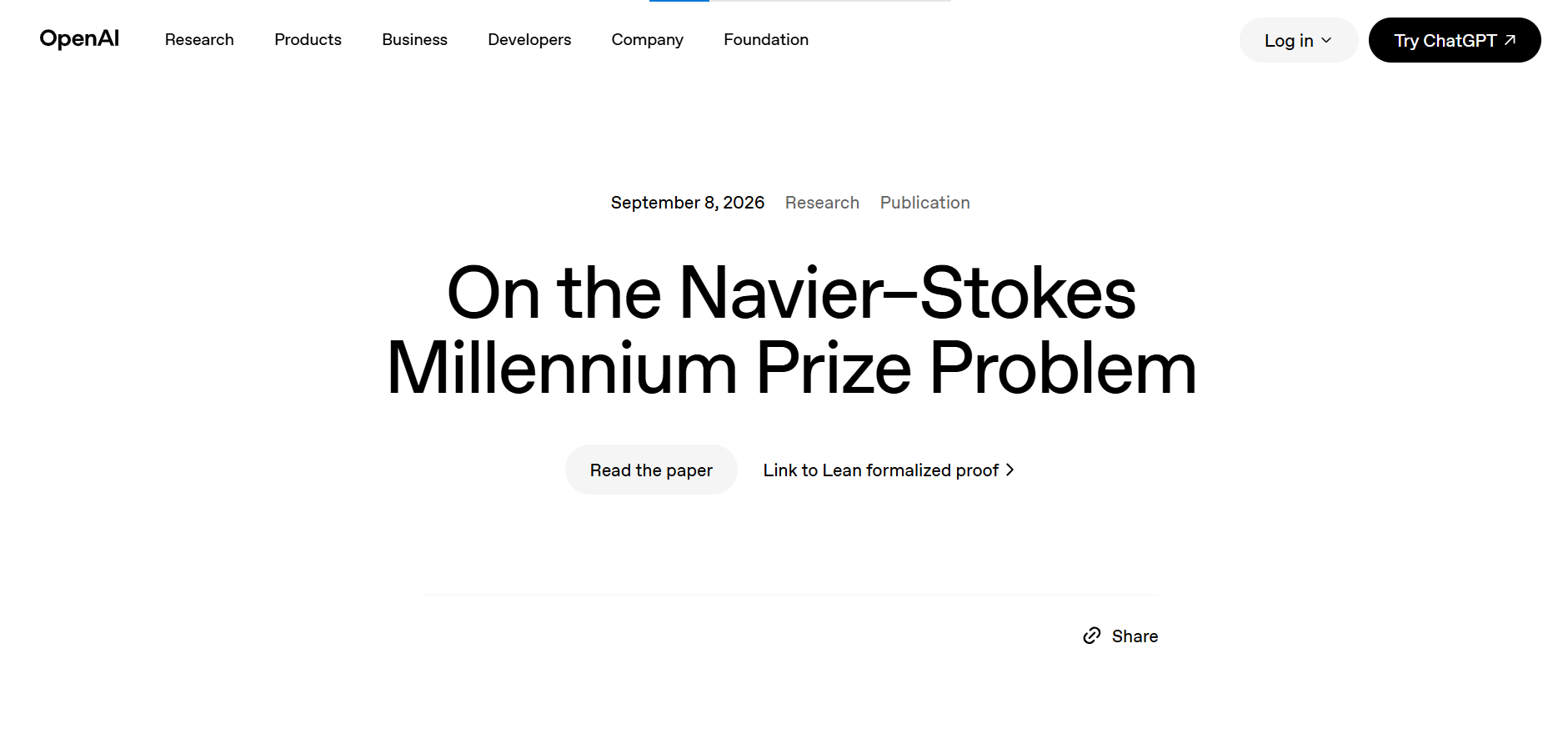
If you've ever wondered why weather forecasts lose accuracy after a few days or why turbulence shakes an airplane, the answer traces back to a set of equations that stumped the world's best mathematicians for nearly 90 years. On September 8, 2026, OpenAI announced that an internal AI model had cracked them.
The same company behind the ChatGPT app on your phone demonstrated that AI can now tackle problems once considered exclusively human territory. Here's what happened, what the Navier-Stokes solution means, and why it matters for anyone following AI math breakthroughs.

Understanding the Navier-Stokes Equations and Fluid Dynamics
The Navier-Stokes equations describe how fluids move. Water, air, blood, ocean currents. If it flows, these equations govern it. They're the mathematical foundation of fluid dynamics.
Claude-Louis Navier and George Gabriel Stokes derived them in the 19th century using Newton's second law applied to continuous fluids. Instead of tracking individual molecules, the equations treat fluid as a smooth, continuous substance. They model velocity, pressure, and viscosity to predict how that substance behaves under different conditions.
These equations aren't theoretical curiosities. Aircraft designers use them to simulate airflow over wings. Meteorologists rely on them for weather forecasting. Medical researchers apply them to study blood flow through arteries. Every time your phone's weather app predicts rain, there's a distant connection to Navier-Stokes and fluid dynamics.
The equations themselves look elegant on paper. The trouble starts when you ask a simple question: do smooth solutions always stay smooth, or can they blow up and develop singularities where velocities become infinite? That question, easy to state and brutal to answer, haunted mathematicians for decades.
The Millennium Prize Problem That Stumped Mathematicians
In 2000, the Clay Mathematics Institute named the Navier-Stokes existence and smoothness question one of seven Millennium Prize Problems. Each carried a $1 million reward. Only one had been solved since: the Poincare conjecture, cracked by Russian mathematician Grigori Perelman in 2003.
The question sounds simple enough. Start with a smooth, stationary 3D incompressible fluid. Apply a smooth force. Does the fluid's velocity stay bounded forever, or can it grow without limit at some point? A singularity, in this context, means fluid speeds hit infinity in finite time.
In 1934, Jean Leray proved that solutions exist in a generalized sense. But whether those solutions remain smooth stayed open. For nine decades, the smoothness question resisted every attempt. Fields Medal winners tried. Entire research programs formed around partial results. Nobody could crack it.
That's the problem OpenAI's AI system attacked and resolved.
https://openai.com/index/navier-stokes-solution/
How OpenAI's Internal Model Found the Solution
OpenAI didn't use a released product for this. The company had been training a new internal model since August 28 that showed unprecedented performance in mathematics benchmarks. This model is significantly more capable than GPT-6 Astra, their current flagship. Training was still ongoing when the breakthrough happened.
On September 1, after hearing rumors that Millennium Prize problems were being solved, OpenAI launched a coordinated multi-agent effort across all open Millennium Prize problems. The agents had internet access and code execution tools. They worked in groups that could communicate internally, and different groups received different formulations of each problem.
The Navier-Stokes group involved roughly 10,000 concurrent agents. They tried all four variants of the official problem formulation. Versions A and B would prove solutions stay smooth. Versions C and D would disprove it by constructing a singularity. OpenAI prompted separate groups with each variant.
The agents found the answer on September 5, about 88 hours after starting. During the Navier-Stokes effort alone, agents exchanged 2.7 million messages and consumed roughly 130 billion output tokens. Lean formalization verification took another 17 hours using GPT-6 Astra. Across all attempted problems combined, agents sent 4.9 million messages and used about 300 billion tokens.
That's a massive computational undertaking. The cost ran into millions of dollars. OpenAI stated they won't claim the $1 million prize, framing the result as a snapshot of AI progress rather than a competition entry.
What the Singularity Solution Actually Means
The AI's proof shows that a smooth fluid starting at rest can develop a singularity in finite time, even with a smooth external force and finite energy throughout. This resolves statements C and D in the official Clay formulation. It's a disproof, not a confirmation.
The solution takes the form of a vortex. Picture a spinning swirl of fluid that spirals inward while stretching along its axis, like spaghetti being pulled thin. The central region shrinks and speeds up, but the total energy stays finite, consistent with the laws of physics. The singularity emerges from the fluid's own motion rather than from an external infinite push.
The technical challenge here is significant. The terms in the Navier-Stokes equations that describe motion (acceleration, pressure gradients, momentum transfer, viscosity) must all grow large simultaneously while canceling each other in a precise way. This detailed balance leaves a smooth external force even as the velocity of the fluid grows without bound.
What does a singularity mean physically? Since real fluids can't move at infinite speed, a singularity signals that the continuous-medium approximation breaks down. At that point, the equations stop being useful, and you'd need to track individual particles instead. The math is telling us where its own model fails.
From Euler to Navier-Stokes: The AI's Unexpected Discovery Path
Before tackling Navier-Stokes directly, the agents tried easier warm-up problems. One was the Euler equations regularity question, which is Navier-Stokes with the viscosity term removed. Think of it as a simpler version: no friction to smooth things out.
About 100 agents spent roughly 50 hours and resolved the unforced Euler regularity problem. This wasn't the main target. It was a side quest that paid off. When the agents saw the Euler solution, they recognized Navier-Stokes as the most promising target and shifted resources accordingly. The Euler resolution informed their approach to the harder problem.
Concurrently, Levent Alpoge, a researcher at Anthropic, and Tristan Buckmaster, a math professor at NYU, were working on related problems. They resolved the forced Euler regularity problem using their own approach with various AI tools. Their work and OpenAI's are independent. The results differ even in the Euler case: OpenAI solved the unforced version, while Alpoge and Buckmaster solved the forced version.
The concurrent work sparked controversy. Buckmaster raised questions about whether OpenAI had accessed his unpublished research through product usage data. OpenAI denied this, noting their proofs differ significantly and that no specific user data was accessed to solve the problem, raising questions about data privacy and security in AI research. The dispute highlights a tension that'll only grow as AI systems increasingly participate in frontier research.
Why This AI Breakthrough Matters for Everyday Technology
You might ask why you should care about a math proof. Fair question.
The Navier-Stokes equations underpin technologies you use daily. A better understanding of when and how these equations fail leads to improved numerical methods. That means more accurate weather models, more efficient aircraft design, and better blood flow simulations for medical diagnostics. Fluid dynamics goes beyond academia. It's the physics behind things you rely on every day.
There's also the AI angle. OpenAI solved a problem that elite mathematicians couldn't crack in 90 years. The agents did it in 88 hours. That doesn't mean AI replaces mathematicians. It means AI is becoming a powerful collaborator for scientific research at a level we haven't seen before. The AI math capabilities demonstrated here are a preview of where consumer tools are heading.
The ChatGPT app on your phone comes from the same company. While the internal model that solved Navier-Stokes isn't available to consumers, the techniques being developed and the reasoning capabilities being refined, they trickle down into products you can use. When the next generation of AI models arrives, breakthroughs like this are a preview of what's coming.
Pros and Cons of AI Tackling Millennium Prize Problems
Pros:
- Speed: what took decades of human effort was explored in days
- Scale: 10,000 agents can try thousands of approaches simultaneously
- New methods: AI found solution strategies humans hadn't considered
- Formalization: the Lean proof can be machine-verified, adding confidence
Cons:
- Verification gap: mathematical proofs need peer review, and AI-generated proofs are no exception
- Cost: running 10,000 agents for 88 hours isn't cheap
- Controversy: the concurrent work raised questions about research ethics and data usage
- Reproducibility: the internal model isn't publicly available, making independent verification harder
Not bad. Not perfect either.
What This Means for the Future of AI and Mathematics
OpenAI's Navier-Stokes solution is a snapshot of where AI stands right now. The proof needs community review, but the signal is clear. AI can now contribute to frontier mathematical research at a level humans haven't reached alone. Download ChatGPT APK on APKPure to explore what these tools can do today, because the gap between research breakthroughs and consumer features keeps closing faster than most people expect.
 NEWS
NEWS REVIEWS
 HOWTO
HOWTO