

What Is Devin AI? Cognition's Coding Agent Explained

2026-09-10
Devin AI by Cognition is an autonomous coding agent that handles full software engineering tasks. Learn about its features, $48B valuation, and enterprise adoption.

Devin AI, developed by Cognition AI, has become one of the most talked-about tools in the software engineering world. Marketed as the first autonomous AI software engineer, Devin goes beyond simple code completion to handle entire development tasks from start to finish. With Cognition's latest funding round pushing its valuation to $48 billion, the company behind Devin is now worth more than many established tech firms.
What Does Devin AI Actually Do
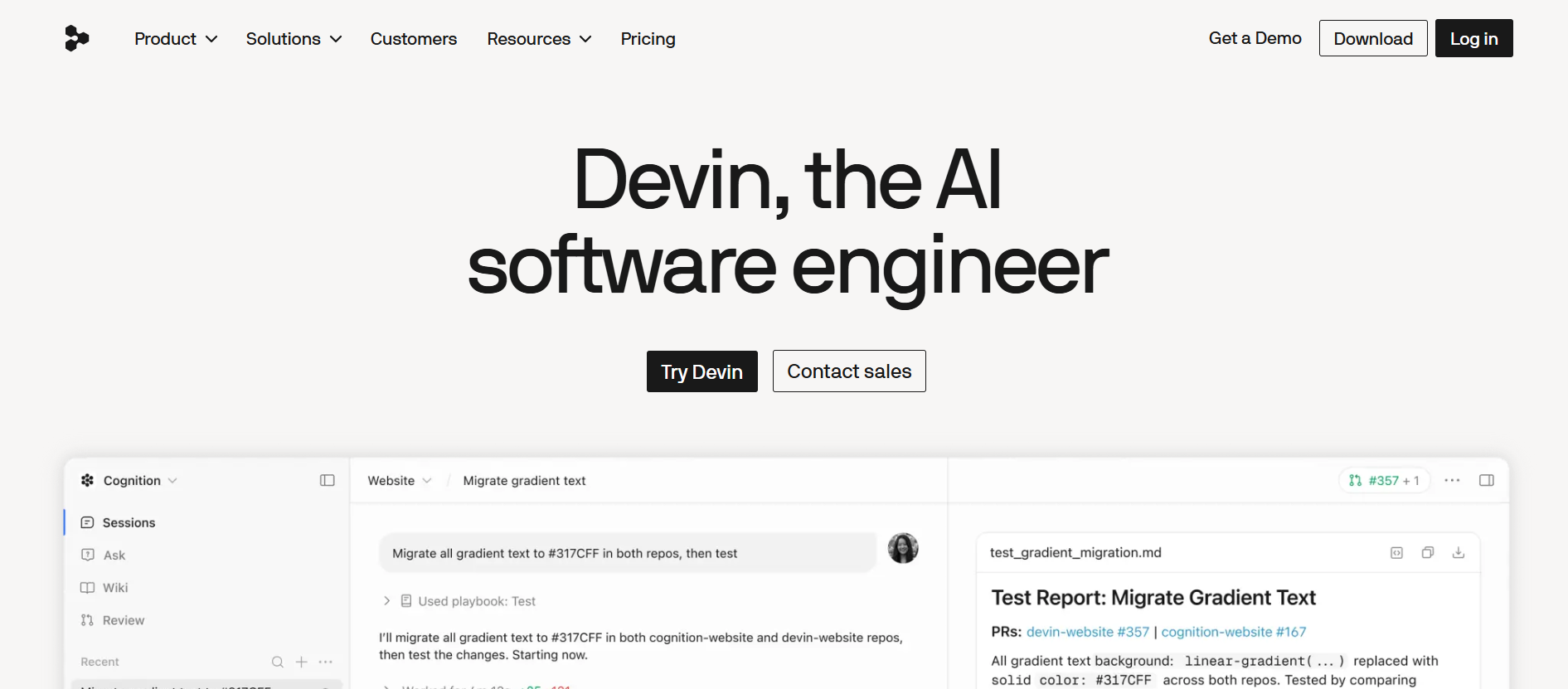
Devin isn't another autocomplete plugin that guesses your next line of code. It operates as an autonomous agent that can take a natural language request, break it into steps, write the code, test it, debug it, and deploy the result. You describe what you need in plain English, and Devin builds it.
The system runs inside its own sandboxed environment with a terminal, code editor, and browser. That means Devin can install dependencies, read documentation online, run build commands, and interact with external APIs without you holding its hand through every step. Cognition calls this approach "task completion" rather than "text completion," drawing a clear line between Devin and tools like GitHub Copilot.
Enterprise teams at NVIDIA, GE Aerospace, Citi, and Mercedes-Benz already use Devin in production. These companies deploy it for repetitive engineering work like writing test suites, migrating legacy code, fixing bugs across large repositories, and standing up internal tools.
Who Built Devin: Cognition AI's Background
Three founders started Cognition AI in late 2023: Scott Wu, Steven Hao, and Walden Yan. All three are competitive programmers with multiple International Olympiad in Informatics (IOI) gold medals between them, which explains their obsession with building systems that solve problems end-to-end rather than one fragment at a time. Wu previously co-founded Lunchclub, Hao was an early engineer at Scale AI, and Yan dropped out of Harvard to join the venture.
The company started in a small New York apartment before moving to San Francisco. Peter Thiel's Founders Fund led the first investment, and subsequent rounds drew in Khosla Ventures, 8VC, Lux Capital, and General Catalyst. Cognition grew from a $3.5 billion valuation in early 2024 to $20 billion within six months, then crossed $100 billion territory by September 2025.
In July 2025, Cognition acquired Windsurf, an AI-powered code editor with over a million users. This gave the company a dual-product strategy: Devin handles asynchronous, cloud-based engineering tasks, while Windsurf works as a daily coding companion inside the developer's IDE.
The $48 Billion Valuation and Series E Funding
On September 8, Cognition announced its Series E round, raising $2 billion at a $48 billion post-money valuation. Andreessen Horowitz (a16z) and Accel co-led the round, with continued participation from Founders Fund and other existing investors.
The funding came fast on the heels of a $26 billion valuation round just three months earlier, where Cognition raised over $1 billion from Lux Capital, General Catalyst, and 8VC. Investor interest reportedly totaled close to $10 billion for that earlier round, meaning demand outpaced available shares by a wide margin.
What drove this valuation? Revenue growth. Cognition's annual recurring revenue (ARR) jumped from $492 million to $900 million between May and September 2026. The company's cumulative net burn sits under $20 million, making it one of the most capital-efficient AI startups relative to its revenue scale.

Key Features: Auto-Triage, Security Swarm, and Automations
Devin's product has evolved well beyond its initial code-writing capabilities. Three features define its current enterprise offering:
- Auto-Triage routes incoming engineering tasks to the right Devin instance based on context, priority, and codebase familiarity. Instead of a human deciding which engineer handles which ticket, Devin reads the issue, understands the relevant code areas, and picks up the work autonomously. Teams using Auto-Triage report that it cuts ticket assignment time from hours to minutes.
- Security Swarm deploys multiple Devin agents to scan codebases for vulnerabilities simultaneously. Each agent focuses on a specific category like dependency issues, injection risks, or configuration problems. The swarm aggregates findings into a single report with suggested fixes, which human engineers can review and approve. Companies in regulated industries like finance and aerospace have adopted this feature for continuous security auditing.
- Automations let teams schedule recurring engineering tasks. A team can configure Devin to run nightly test suites, clean up dead code weekly, or monitor dependency updates and open pull requests when new versions arrive. This turns Devin from a reactive tool into a proactive member of the engineering workflow.
How Devin Compares to Other AI Coding Tools
The AI coding space has consolidated rapidly.
Cursor, one of Devin's closest competitors, was acquired by SpaceX for $60 billion, bringing code editor technology in-house at the aerospace giant. That acquisition removed a major independent player from the market and left Devin as the leading pure-play autonomous coding agent.
GitHub Copilot and similar IDE plugins focus on inline code suggestions. They predict what you'll type next and save keystrokes. Devin targets a different problem: completing entire tasks that would normally take a human engineer hours or days. The distinction matters because productivity gains from code completion cap out around 20%, while autonomous task completion can deliver 10x improvements on certain work types.
Devin also differs from tools like Claude Code or OpenAI's Codex in its deployment model. Those tools run locally or through CLI interfaces, while Devin operates in a managed cloud environment with its own persistent sandbox. This setup lets multiple Devin instances run in parallel on different tasks, something local-first tools struggle with.
What Devin's Growth Means for Software Engineering
The revenue numbers tell a clear story. When a software tool reaches $900 million in ARR within three years of launch, it has crossed from experiment to infrastructure. Companies aren't running pilots to see if this technology works. They're budgeting for Devin the same way they budget for cloud infrastructure or CI/CD pipelines. The Devin coding assistant has moved from an experimental side project to a line-item expense in engineering budgets at major corporations.
But Devin hasn't eliminated the need for human engineers. Cognition's own guidance compares working with Devin to managing a team of junior developers. Senior and staff engineers adopt it fastest because they already know how to delegate, review work, and provide constructive feedback. The tool handles repetitive implementation work while humans focus on architecture decisions, business logic, and cross-system design.
The areas where Devin still struggles are predictable: deeply custom business logic that requires domain expertise, system architecture decisions that involve tradeoffs across multiple teams, and novel problems where no existing codebase or documentation provides a pattern to follow. For everything else, the gap between "AI-assisted" and "AI-completed" keeps narrowing.
Conclusion
Devin AI represents the most commercially successful attempt yet at building an autonomous software engineer. Backed by $2 billion in fresh funding and a $48 billion valuation, Cognition AI has the resources to keep pushing the boundary of what coding agents can handle. With enterprise customers like NVIDIA and Mercedes-Benz already paying for Devin at scale, the question is no longer whether autonomous coding agents will catch on, because they already have. The real question is how far up the engineering complexity ladder Devin can climb before hitting its next ceiling, and what the software industry looks like when that boundary keeps moving.
 NEWS
NEWS REVIEWS
 HOWTO
HOWTO