

What Is Faraday? The Inherent AI Agent That Beats Claude and GPT

2026-08-25
Faraday is an AI agent from Inherent that beats Claude and GPT at reproducing scientific papers. Here's what it does and why it matters.
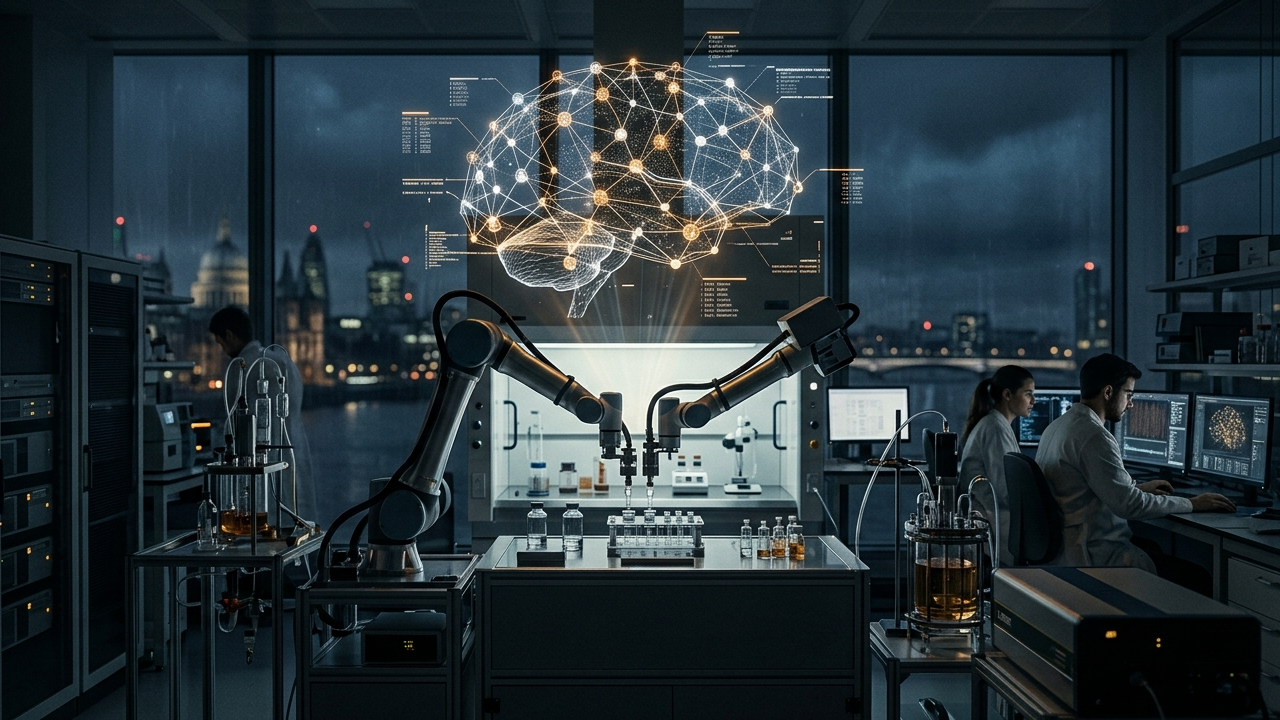
The race for AI-driven scientific research gained a new name in August 2026. Faraday, an autonomous agent built by the British startup Inherent, reproduced published scientific papers with higher accuracy than much larger models. The result turned heads because Faraday outperformed Anthropic's Claude Opus 4.8 and OpenAI's GPT-5.5 on a task few systems can complete on their own.
If you follow AI developments, the name DeepMind comes up a lot. Now, former DeepMind researchers founded Inherent and are applying what they learned in a different direction. Instead of building ever-larger models, they trained a relatively small model to think like a researcher. The difference is in the approach, not the size.
What Is Faraday and Why It Matters
Faraday is an AI agent designed to reproduce experiments described in published scientific papers. It reads the paper, understands the methodology, writes the necessary code, runs the experiments, and validates whether the results match the originals. All of this happens without access to the source code or the correct answers.
Reproducing papers is exactly what PhD students do as training exercises. A doctoral candidate receives a paper, tries to reimplement the described method, and checks whether they reach the same results. It's a fundamental step for developing what researchers call "research taste," the ability to judge which experiments are worth running and which results are trustworthy. Faraday does this same process on its own.
This matters because scientific reproduction is one of the slowest bottlenecks in academic research. Labs spend months trying to reimplement published methods, and many never succeed. An AI agent that does this well can accelerate science in ways that go beyond writing code.
Who Is Inherent, the Lab Behind Faraday
Inherent is an AI lab based in King's Cross, London, founded by former Google DeepMind researchers. The cofounders include Louis Kirsch, Kaloyan Aleksiev, Tantum Collins, and Edward Hughes, who serves as chief scientist. The company emerged from stealth mode in May 2026 and announced a $50 million seed funding round.
With about 12 employees currently, Inherent is a compact operation compared to the labs that built Claude and GPT. The team works from offices in central London and plans to grow to 20 or 25 people by the end of 2026. The small size reflects the company's philosophy: solve hard problems with better algorithms, not more parameters.
Inherent's stated mission goes beyond reproducing papers. The team wants to build AI that can discover new scientific knowledge, formulate novel hypotheses, and run end-to-end research pipelines. Paper reproduction is the first validation step in that direction.
How Faraday Beats Claude and GPT in Scientific Reproduction
The numbers from Inherent show that Faraday achieved higher reproduction fidelity than Claude Opus 4.8 and GPT-5.5 in blind evaluations. In the tests, each model received published scientific papers and had to reimplement the methods without access to the original code or reference results.
This is surprising because Faraday runs on a much smaller architecture. Claude Opus 4.8 and GPT-5.5 are frontier models with hundreds of billions of parameters. Faraday was built on Alibaba's Qwen 3.6, which has 27 billion parameters, a fraction of the size of the models it defeated.
The explanation isn't in size but in training. Inherent applied reinforcement learning algorithms focused specifically on experimental design, hypothesis testing, and error correction. The model learned to prioritize experiments with high informational return and to evaluate whether empirical results make sense. That specialized training makes the difference on structured tasks like paper reproduction.
Inside the Faraday AI Agent Architecture
Faraday doesn't try to do everything alone. It works as an agent that coordinates different tools to complete the reproduction of a scientific paper. For code generation and execution tasks, Faraday delegates to OpenAI's GPT-5.5 Codex. That decision follows the logic of a real lab, where researchers use existing software instead of building everything from scratch.
The base architecture is Qwen 3.6 27B, an open-weight model from Alibaba. On top of that base, Inherent trained what they call "research taste" using reinforcement learning. This training teaches the agent to make decisions a good researcher would make: which experiment to run first, how to interpret ambiguous results, when to try a different approach. The training focus wasn't on memorizing methods but on developing the ability to judge empirical validity.
The process runs in cycles. Faraday reads the paper, extracts the methodology, plans the necessary experiments, writes instructions for Codex to generate code, runs the tests, and analyzes whether the results match the published ones. If something fails, it adjusts and tries again. This loop of hypothesis, test, and correction is the core of the method.
Faraday vs Other AI Agents: How They Compare
The fundamental difference between Faraday and models like Claude and GPT is purpose. Claude and GPT are generalist models designed to handle any task, from drafting emails to data analysis. Faraday was trained specifically for scientific reproduction, with reinforcement learning in a focused domain.
In terms of size, the gap is significant. Frontier models from Anthropic and OpenAI run on massive clusters with hundreds of billions of parameters. Faraday operates on 27 billion parameters over the Qwen 3.6 architecture. That difference means lower inference costs and greater accessibility for research labs that don't have tech-giant budgets.
On the other hand, Faraday isn't a general-purpose assistant. It won't write an email or create a presentation. Its utility is restricted to the scientific domain, specifically in reproducing and validating experimental results. Models like Claude and GPT remain the better choice for general language and coding tasks.
Advantages and Limitations of Faraday
The main advantage of Faraday is proving that specialized training beats raw scale on structured tasks. A 27-billion-parameter model outperformed systems hundreds of times larger because it was trained with a focus on scientific research. This opens the door for smaller labs to compete in specific niches without billion-dollar budgets.
Another positive point is the modular approach. Faraday doesn't build its own code tools. It uses GPT-5.5 Codex for that part, which reduces complexity and lets Inherent focus on what it does best: scientific reasoning. This division of labor mirrors how real labs function.
The limitations are clear too. Faraday is still a young system, launched in August 2026, and needs more independent validation outside Inherent's own benchmarks. Paper reproduction is an important task, but it's just the beginning of the path toward AI that discovers new knowledge. There's no guarantee that the same training works equally well for formulating original hypotheses. The dependency on GPT-5.5 Codex for code means the final quality depends partly on a third-party system.
A safety note: Faraday executes auto-generated code, which carries privacy and security risks when run in uncontrolled environments. Labs that want to test similar systems need to ensure their execution environments are isolated. Anyone looking to install and test scientific AI tools on Android can search for research assistant apps in the app stores, but Faraday itself doesn't have a public release yet.
Conclusion: What the DeepMind Connection Means for AI in Science
The DeepMind name appears here because Inherent's founders came from there, and that background explains part of their approach. DeepMind has always combined reinforcement learning with long-term goals, from AlphaGo to AlphaFold. Faraday follows the same philosophy: train a model with RL to master a difficult task, rather than just scaling up parameters.
Inherent plans to expand the team to 25 people by the end of 2026, which suggests more results are coming. If Faraday can move from reproduction to original knowledge discovery, we'll be looking at a real shift in how scientific research happens. For now, it has already proven that size isn't everything when training is done with care. Anyone following AI should keep an eye on Inherent's next steps and try the tools as they become publicly available.
 NEWS
NEWS REVIEWS
 HOWTO
HOWTO