

What Is OpenAI Agents API? A Practical Guide for Android Users

2026-09-15
OpenAI's Agents API beta gives developers production-grade AI agents in a single API call. Here's what it means for Android users and the apps on their phone.
OpenAI launched the Agents API on September 10, 2026, and it changes what AI can actually do on your phone. Instead of just answering questions, AI can now run tasks end to end. Book a flight, sort your files, debug code, send emails. All without you babysitting every step.
If you've used ChatGPT on Android, you've already seen pieces of this. The Agents API takes the same infrastructure that powers Codex and ChatGPT for Work and hands it to developers everywhere. No extra subscription. No enterprise contract. Just a standard API call.
Here's what that means for you, how it works, and why it matters for the apps you use daily.
What Is the OpenAI Agents API?
The OpenAI Agents API is a public beta that gives developers a way to build AI agents that run in the cloud and handle multi-step tasks on their own. An "agent" here isn't a chatbot that waits for you to type something. It's a worker that takes a goal, figures out the steps, uses tools, and delivers a finished result.
Before this, if a developer wanted to build an AI that could actually do things (not just talk), they had to stitch together a bunch of infrastructure. Context management, tool routing, sandbox environments, error recovery. That's months of engineering work. The Agents API does all of that in one call.
The key detail: it's the same harness that powers Codex, OpenAI's coding assistant. They've been running this internally, ironing out the bugs, and now they've opened it up. The openai agents api is not a wrapper around existing tools. It's the production-grade system that has already handled millions of tasks.
How the Agents API Works
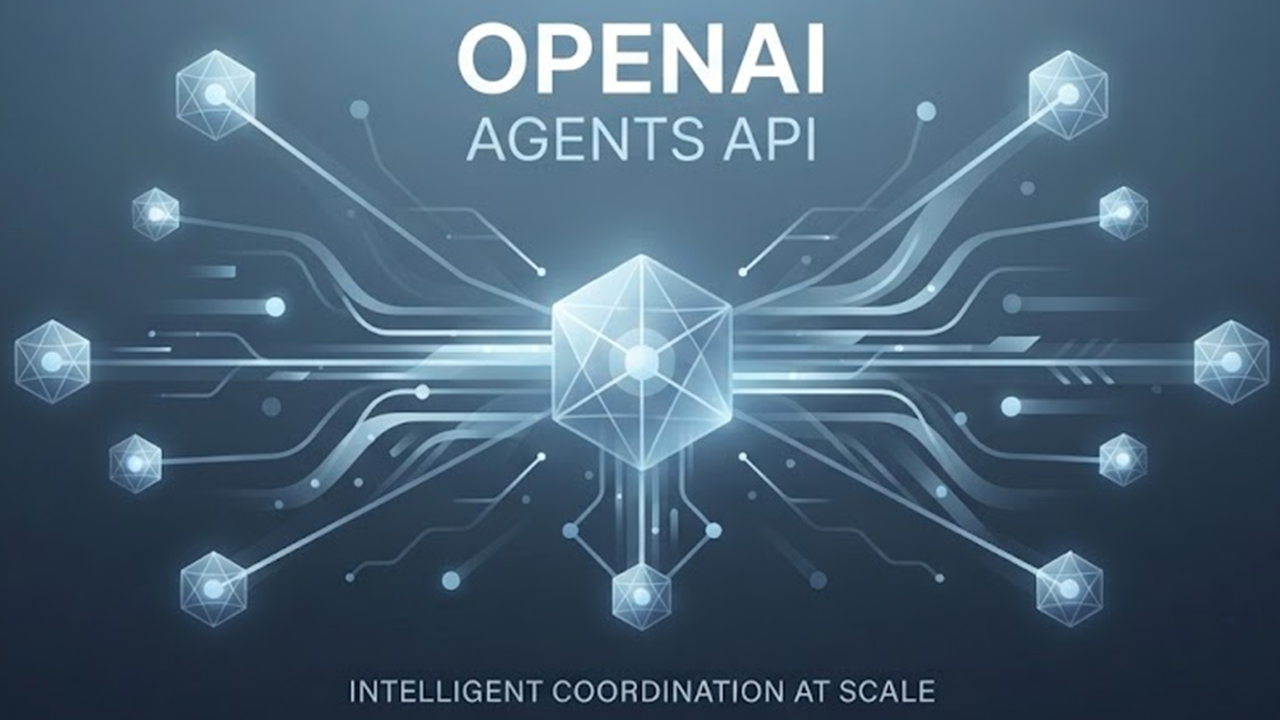
Think of the AI agents api as a three-part system. There's the model (the brain), the tools (the hands), and the environment (the workspace). You tell the API what you want done, pick a model, give it tools, and choose where it runs.
The harness does the heavy lifting. When a conversation gets too long, it automatically compresses earlier context so the agent can keep working for hours or even days. When there are too many tools loaded, it searches through them on demand instead of stuffing every tool definition into every request. That saves tokens and reduces errors.
For execution, agents run in sandboxed environments. You can pick OpenAI's hosted sandbox or go with partners like Cloudflare, Daytona, E2B, Modal, or Vercel. The agent can write code, run it, read files, save intermediate results, and pick up where it left off if something breaks.
The codex harness is open source, which means developers can inspect how it works, contribute improvements, and trust that there's no hidden magic. OpenAI handles the hosted version, so you don't need to maintain infrastructure yourself.
Key Features of the Agents API
A few things make this different from a regular OpenAI API call.
- Context auto-compression. Long-running tasks eat up context fast. When the conversation approaches the model's limit, the API compresses earlier turns into summaries. The agent remembers what matters and forgets what doesn't. This is what makes hours-long tasks possible.
- Tool search. If you've given an agent 50 tools, loading all of them into every request would burn through tokens. The API loads tool definitions on demand. The agent figures out which tool it needs, the API fetches that definition, and off it goes.
- Multi-agent coordination. Complex tasks get split up. A main agent can spin up sub-agents that work in parallel, each with its own context. One agent researches, another writes code, another tests. They share a file system but think independently. The main agent collects the results.
- Sandboxed execution. Agents run in isolated environments where they can execute code, handle files, and store state. You control the network access. Three levels: full internet, no internet, or restricted to a whitelist of domains.
Practical Uses for Android Users
You won't call the agents api beta yourself. But the apps on your phone will. Here's what becomes possible.
A productivity app could let you say "plan my trip to Tokyo next month." An agent researches flights, checks your calendar, compares hotels, and presents a complete itinerary. You approve, and it books everything. No app switching, no copy-pasting between tabs.
A coding app could let you describe a bug. The agent reads your codebase, finds the issue, writes a fix, runs tests to verify, and shows you the diff. That's what Codex already does, and now any developer can build similar experiences.
A file manager could use an agent to organize your downloads. "Sort everything from last week by type and rename the screenshots." The agent does it in the cloud and syncs the result back to your device.
These aren't hypothetical. Early customers like SafetyKit cut per-case processing costs by 60%. Hypha reduced agent failure rates by 86%. Cirridae improved evaluation scores from 0.71 to 0.85 while cutting latency by 4x.

OpenAI Agents API Pros and Cons
The benefits are real, but this is a beta product with rough edges.
What works well:
- Single API call to create a production-ready agent. The developer experience is genuinely simple.
- No extra cost beyond token and tool usage. You pay for what the agent consumes, nothing more.
- Flexible sandbox options. Pick OpenAI's hosted environment or bring your own.
- The harness is battle-tested. It's been running Codex for months at scale.
What to watch out for:
- It's a beta. APIs can change, features can break, and documentation has gaps.
- Data residency is locked to US servers. If you need data to stay in a specific region, that's not available yet.
- Sub-agents share a file system. If two agents write to the same file simultaneously, you need coordination logic.
- Zero Data Retention mode isn't supported, even if you bring your own sandbox.
- Privacy controls are still developing. Review what data your agent collects and where it's stored before deploying in production.
Agents API vs. Other AI Agent Platforms
Google has Managed Agents through Gemini, and Anthropic offers agent capabilities through Claude. The openai api stands out in a few ways.
The harness is open source. You can read the code that runs your agents. That's rare in this space. Most platforms keep their agent infrastructure closed.
The range of sandbox partners is broader. Cloudflare, Daytona, E2B, Modal, Vercel, DigitalOcean, Oracle, Runloop, and Blaxel. That gives developers choices across price points, regions, and compliance requirements.
Pricing is straightforward. No platform fee. You pay for model tokens and tool calls. If an agent uses 10,000 tokens and 5 tool calls, that's what you pay. Google and Anthropic have more complex pricing models for their agent platforms.
The tradeoff is vendor lock-in. The Agents API routes through OpenAI's endpoints. Even if you bring your own sandbox, model inference goes through OpenAI. Google's approach lets you choose from multiple model providers.
Getting Started With the Agents API
For developers, getting started takes minutes. Create an OpenAI account, generate an API key, and make a single API call. Specify your task, model, tools, and environment. The agent starts running.
The API speaks standard REST. You send a POST request with your task parameters, and the API responds with a session you can interact with. Events stream back via SSE or webhook, so you can watch progress in real time.
For Android users, the payoff comes when your favorite apps integrate this. Apps that currently make you do manual steps between services will start handling the whole flow. That's the promise of the ai agents api. Not a smarter chatbot, but a capable assistant that finishes what you start.
If you want to see what AI agents feel like on your phone today, download the ChatGPT app. It's the most accessible way to experience what the Agents API makes possible. The same infrastructure is now available to every developer building for Android.
The Agents API isn't a finished product. It's a public beta with real limitations. But it's the first time OpenAI's production agent infrastructure has been available to anyone with an API key. That matters because the apps on your phone are about to get a lot more capable. Tasks that used to require switching between five apps will happen in one. And the agent won't just talk about doing it. It'll do it.
 NEWS
NEWS REVIEWS
 HOWTO
HOWTO